
Latest version:5.0.1 build 119.January 19, 2026.
The MODBUS RTU/ASCII and MODBUS TCP plugins provide a complete set of functions for industrial data acquisition and protocol emulation. It supports master mode for active polling, slave mode for device emulation, and passive mode for bus monitoring. The plugin decodes requests and responses, verifies checksums, parses registers and bits, and prepares data for exporting to files , Excel, or databases. It also supports custom formulas for response items and flexible grouping of exported rows.
As a MODBUS master, the plugin sends requests such as function 3 (read holding registers) or function 4 (read input registers). For example, request a sequence of five registers from device 10 with first register offset 99 and registers to read 5. The plugin calculates the checksum, sends the packet, waits up to the configured request timeout, parses the response and extracts each register as configured types. Example request parameters: Device address = 10, Function = 3, First register = 99, Registers to read = 5, Request timeout = 2000 ms.
In slave mode, the plugin emulates one or multiple MODBUS devices and responds only to valid requests from a master. For example, emulate device address 20 with holding registers (function 3) mapped from offset 0 to 99. If a PLC writes single register 40100 (offset 99) the plugin stores that value and can export it immediately. Slave mode supports function codes 1, 2, 3, 4, 5, 6, 15, and 16 and returns appropriate exception codes for out of range accesses.
In passive mode, the plugin acts as a bus monitor. When used with a serial RS485 spy port, it parses both requests and responses but never transmits. For example, when a master requests device 5, function 3, address 40010 for two registers and the slave replies, the plugin verifies the checksum, decodes the two registers, applies any custom formula and exports the data. Enable “Export changed values only” to reduce output noise when polling is frequent but values change rarely.
Key request fields: Device address (0-255, can be comma separated like 1,2,3,4), Function (for example 3 or 4), Data address using full notation (for example 40001) or First register offset (zero based), “Registers to read” and “Request timeout”. Use “Export data for all requests at once” to group multiple request results into one exported row when you poll the same device in several requests.
When emulating a slave device, set Active, assign Device address or addresses, select supported Function (0 for all or a combination such as 1,3), choose Data address and Registers to read to define the memory range and optionally add named Response items with data types and offsets. If you leave Response items empty, values export as unsigned 16-bit decimals with autogenerated names like VNNNNN or BNNNNN.
Example 1: Master polling RS485 device
Example 2: Passive bus monitoring using the same logger
The MODBUS RTU and TCP module allows reading and logging data from devices that use the MODBUS protocol. It can operate in master and slave modes with configurable data parsing, checksum handling, and custom formulas.
The figure below shows how to select the plugin on the “Modules” page.
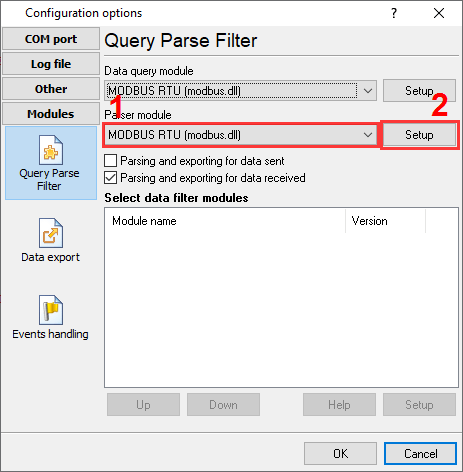
Fig.1. Selecting the plugin.
The figure below shows how to configure the plugin. Please, look at the documentation for the full description of all settings.
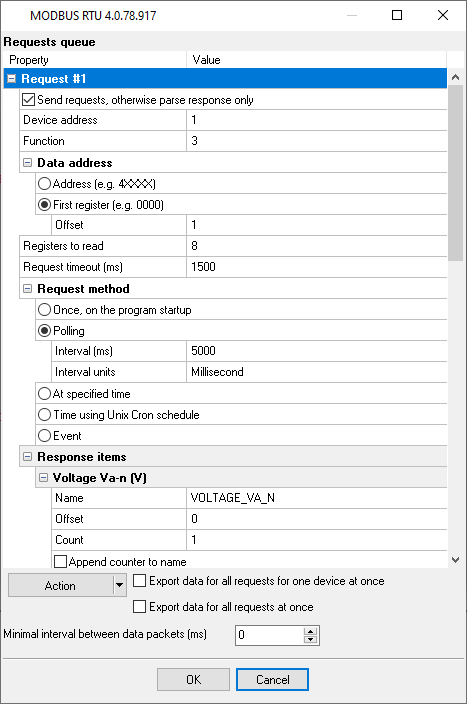
Fig.2. Configuring the plugin.
All plugins | MODBUS RTU, MODBUS TCP, MODBUS ASCII | M-Bus | Bacnet/IP | IEC 62056-21 | DLMS/COSEM | DL-T645-2007 | CJ/T 188-2004 | Kamstrup [KMP protocol]