
Latest version:5.0.1 build 1126.November 28, 2025.
This module integrates RFID readerswith Equvera CoNNeX Data Logger Suite, Equvera CoNNeX TCP/IP Data Logger, or Data Logger Suite. It acts as RFID middleware: it configures readers, receives and parses tag reports, applies pre-filters, and forwards structured variables to export modules or writes them to log files and databases. The module supports both client and server TCP/IP modes and EPC data logging for Class-1 Gen-2 tags.
Typical deployment places the Data Logger software on a central collection server. Readers interact with tags and send data to the logger over TCP or COM port. Depending on your network design and a RFID reader operation mode, configure either the logger as a TCP client or TCP server.
The module configures reader behavior automatically after a connection is established. You can set reader operation parameters such as converting UTC timestamps to local time, start interval for tag detection, detection duration, and antenna power behavior. These parameters trade off data granularity and traffic.
Data flow is deterministic:
Example 1: Low traffic monitoring: configure the reader to start detection every 30 seconds and detect for 2 seconds. Set the logger to log only “When tag appears in field of view” and “When tag disappears from FOV”. The system will generate events only on transitions, reducing stored records while capturing presence changes for inventory gates.
Example 2: High-resolution analytics: set continuous detection (interval 0) and the “Every reading” logging option. This generates a stream of reads that includes RSSI and count per read. Use this mode for detailed tag movement analysis between antennas.
Configuration steps for an LLRP-compatible reader:
Sample incoming LLRP-derived data (raw conceptual view):
LLRP TagReport: EPC: 300833B2DDD9014000000000 AntennaID: 2 PeakRSSI: -62 FirstSeenUTC: 2026-01-02 08:00:00 LastSeenUTC: 2026-01-02 08:00:02 TagSeenCount: 3
After parsing and applying the “When tag appears” filter, an export module receives variables:
DATE_TIME_STAMP = 2026-01-02 08:00:00 TAGREPORTDATA_EPCDATA = "300833B2DDD9014000000000" TAGREPORTDATA_ANTENNAID = 2 TAGREPORTDATA_PEAKRSSI = -62 TAGREPORTDATA_FIRSTSEENTIMESTAMPUTC = 2026-01-02 08:00:00 TAGREPORTDATA_LASTSEENTIMESTAMPUTC = 2026-01-02 08:00:02 TAGREPORTDATA_TAGSEENCOUNT = 3
Exported CSV row example (file exporter):
2026-01-02 08:00:00,300833B2DDD9014000000000,2,-62,2026-01-02 08:00:00,2026-01-02 08:00:02,3
The LLRP Reader Protocol module for our data loggers enables enterprise grade RFID middleware functionality, including reader control, event filtering, and structured exports to fit inventory, access control, or tracking workflows.
The figure below shows how to select the plugin on the “Modules” page.
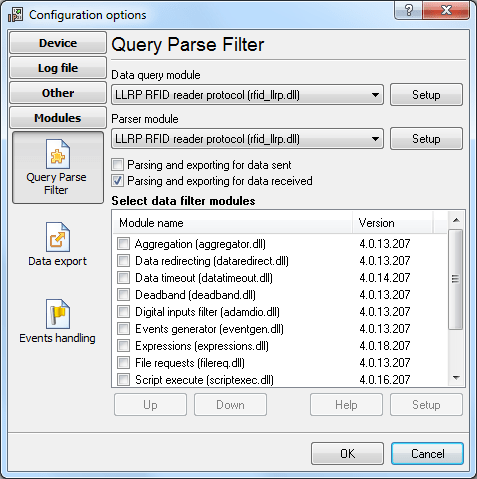
Fig.1. Selecting the RFID reader plugin.
The figure below shows how to configure the plugin to poll the device every 3 seconds. Of course, you may change the poll interval as you want. The ” Tutorials” section contains some detailed tutorials about this plugin.
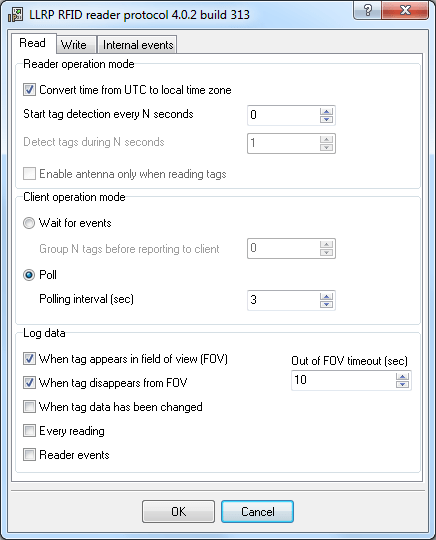
Fig.2. Configuring the plugin.
Alien ALR-9900+ (LLRP)Impinj Speedway R420 (LLRP)Impinj Speedway R220 (LLRP)Intermec IF2 (LLRP)Intermec IF61 (LLRP)Motorola FX7400Motorola FX7500Motorola FX9500ThingMagic Mercury 6 (LLRP)Or any other readers that support the LLRP protocol.NetRFIDAska UHF [VI88]Chafon [5100,5200,R2000]Chafon [5300,5400,5500,5600]Chafon [ASCII format]Chafon [E700]Hopeland [RS232,RS485]Hopeland [TCP]IdTronic UHF [Bluebox]Innod [IND900,IND8600]Invelion [YR8000]Noname UHF [V1]Noname UHF [V2]Omron UHF [RS232,V750,V740]Omron UHF [TCP,V750,V740]RFID SAAT-800 [RS232]RFID SAAT-800 [TCP]Zotei UHF [STU,ZT-STU,ZT-RY]
All plugins | ASCII Data Query and Parser | MODBUS RTU, MODBUS TCP, MODBUS ASCII | Scale Data Parser | DNP3 protocol | GE Fanuc Automation PLC (via CCM, SNP, SNP-X protocols) | Siemens SIMATIK PLC (S7-200, S7-300, S7-400, S5) | EtherNet/IP | M-Bus | Bacnet/IP | IEC 62056-21 | DLMS/COSEM | DL-T645-2007 | CJ/T 188-2004 | Kamstrup [KMP protocol] | Data parser module for ADAM, ICP-CON and NuDAM devices | RFC3164 (syslog protocol) data parser | HTTP data parser | File requests | XML Data Parser | CSV or delimited data parser | RFID Protocols Data Parser (LLRP, ISO 18000-6B, ISO 18000-6C) | JSON parser